Sunday, January 22, 2023

Moving to Markdown

In one sense, it's a no-brainer to move away from Blogger. The interface is archaic and unpredictable, the platform is limited in capability, and as a free Google product, it could get 86'd at any moment. But I've just built up a certain momentum, and even when the activation energy of blogging is too high, the costs of switching seem incredibly higher.

The real issue for me is that the drafts I keep locally never exactly match the finished versions that get pushed. Every post has two or three versions, and none of them would allow me to rebuild if I lost them all.

So I'm moving to blot.im for now, which also gives me the flexibility to eventually switch to Jekyll or a self-hosted instance or anything else with minimal effort. But it will be annoying at first. After this post (which I am posting to Blogger and blot both), I will only be making new posts on blot. And I may take some time to do it, but I plan to take this opportunity to slowly revisit and convert my old Blogger posts.

And hopefully, the overhead of putting out a new post will be much lower, so I've got a handful of things lined up already.

Wednesday, November 23, 2022

Le Monastère de Saint Gastronomie (Review)

A whimsical mini-campaign set in rural medieval France. Players are monks who must gain the allegiance of local monstrous factions in order to save the world. Due to the nature of the system and adventure, it will be difficult to avoid spoilers in this review.

The adventure was part of Kickstarter’s third Zinequest event, and available as a reward. I have not yet found it for sale outside of that. The PDF is 36 pages, written and illustrated by Guy Potts. It includes “standee” paper miniatures for all of the monsters and monks.

UPDATE: You can now buy the game on itch for $7.50!

The System

It comes with a light set of rules that would be easy to swap out, but it would be a shame to do so entirely. The core of these is three stats, roll-over stat checks, a neat little initiative mechanic, and so on. But it also has three key elements that make the system feel tailored to the adventure: miracles, sins, and the timeline. I would consider grafting these subsystems into any game I ultimately used.

As all the characters are monks, there are no class options, spell lists or starting equipment. But there is magic! Before starting, the GM makes a secret list of specific miracles (“create a spring,” “bring a statue to life,” etc.). Characters can pray freely, and if they happen to ask for a miracle on the list, once per monk per campaign, that miracle is granted. (14 miracles are provided to start, with space for four more.)

Similarly, the GM is encouraged to create a list of “sins” (perhaps modeled on existing religious ideas). (Even without a list, certain actions in the module are defined as sins.) Whenever a monk sins, that player marks a circle on their character’s sin-o-meter. Then, the GM rolls 3d6, re-rolling one non-6 result for each sin marked. If the result is “666,” then each character takes a permanent damage. Characters who die this way are especially dead. I think this is a fun and thematic way of handling morality. It allows for a lot of luck-pushing and emphasizes the religious nature of the characters without punishing them outright for making hard choices.

Finally, the whole game takes place over 28 days, so time taken to heal or travel becomes important. This also informs the other two mechanics in their scope: players may choose not to “save” their miracles or may be more reckless with their sins, given this limit.

The Campaign

The adventure provides a compelling amount of direction for a sandbox. The characters are summoned by a dying monk to stop the current abbot (Pierre the Pious) from summoning an angel of death to purge the world of sinners, annihilating France. To do this, they need to recreate the three traditional products of the abbey under the old abbot (Reynard the Rotund): beer, wine, and cheese. Then they must barter them with local monstrous factions in exchange for their support in the coming battle.

The adventure is seven hexes with the monastery at the center, and each hex has an overland map and an underground dungeon. Three hexes house the monstrous factions and three hexes contain the supplies and equipment the monks will need to reproduce the recipes and arm themselves. The whole map is full of connections and secrets.

The Good

The adventure exudes charm from the art, the tone, the scope. The included system is elegant, as are the mechanics found throughout for dungeon elements, puzzles, social interactions, traps, and so on. (To be sure, the art in this review is not the style of the art in the book, which all matches the cover much more closely.)

It claims to be targeted at absolute beginners, and I believe it. It’s friendly in tone and well-considered in many small ways, from using only d6s to laying out the maps in a radial manner (so that they are easily covered by simple fog-of-war effects, or even sticky notes). In particular, I appreciate that it provides many opportunities to fill in some blank spaces, but it never feels incomplete without them.

The Bad

The adventure sits in a weird place as a drop-in. Not too much relies on the players being monks, so you could drop other characters in pretty easily. (If you’re the planning type, you could even have them meet Brother Bartholomew beforehand.) But the climactic battle seems like an end-of-campaign event that would be hard to continue after, and the tight timeline doesn’t leave much room for side-quests. It’s also slightly too long to run as a one-shot.

I’d like to know more about Pierre and his ritual. The book mentions that he will be out of town if the players think to kill him. But it’s unclear if the ritual could be prevented some other way. Does it have to happen in the palace? (Then could Pierre just be kept out?) Is timing important, or is Pierre just too busy to cause the apocalypse right away? (Then could he be delayed or misled?) If this is a Watchmen scenario, why bother keeping him away on business? Ultimately I’m not too worried about this because the draw of supernatural agriculture is probably pretty good and the clues leading to it are plentiful. But I do expect these questions to come up.

For all the interweaving and jacquaying, the PDF would benefit from hyperlinks, but it is short enough that it’s OK without.

Conclusion

I was expecting a short adventure, but instead I found a small world, full of character and innovation, with well-crafted support for its unique size. I wish I could tell you to buy this, but it doesn’t seem possible at the moment. I’ll update this if that changes. (UPDATE: This has changed! you can now buy it here! I recommend it!)

Wednesday, September 28, 2022

Ritual Entrances of the Palace Semi-Infinite

One of the main inspirations for the Palace Semi-Infinite is The Gardens of Ynn, and one of the things I love about Ynn is the ritual entrance. While I prefer to keep the exact relationship between the palace and reality nebulous, this is an option I'd consider for similar ritual entrances.

The Main Entrance

Anyone can get to the Palace with an invitation. A valid invitation must:

  • be written in ink. Some frequent visitors even tattoo their invitations, although this is considered gauche.
  • state the parties invited. The scope can be specific ("Jane Doe") or broad ("the bearer of this invitation") but must be somehow limited in number ("with a retinue of not more than seven") and time ("before the feast of St. Alouicious in the year 2003").
  • be signed. An invitation will not work for the person who signs it, even as a plus one.
  • be written (technically, only signed) inside the Palace.

Present your invitation to a guard or doorman at the entrance to any building and convince them to open the door for you. When you pass through, you will arrive in a random (but consistent) room of the Palace. (Some people claim that the guard must "announce" your arrival as part of the ritual, but this is in fact unnecessary and increasingly old-fashioned.)

The Servant's Entrance

  1. Find a coin on the ground that is not yours and which you did not see drop. It must be worth at least 12 of a smaller denomination of coin. Pick it up and keep it.
  2. Recite: "I, [insert name], gladly accept this payment for a week's honest work."
  3. Enter thru any unwatched door.

You are marked as a servant of the Palace for the next week. This means:

  • a small bonus to remain unobserved by palace inhabitants (other than servants).
  • a penalty to the reaction rolls of palace inhabitants.
  • you are unable to sign invitations to the palace.

At the end of the week, you will be ejected from the palace (if you haven't escaped already), unless you secure more stable employment first.

Monday, September 26, 2022

Other Crews

Rival adventuring parties are a classic device. But if I expect one to appear more than once, I'd like to make it an explicit foil to the party, differing most in only one aspect. This is not a complete taxonomy, only a brainstorm of common narrative roles.

Aspirational

Anything you can do, these guys do better. In the best case, they're friendly and distant, fighting far-off battles. Maybe they like you and occasionally check in. Maybe they really like you and they'd go so far as to sacrifice for you.

Counterpoint

These guys are Gary: they look down on you and just by chance know all your weaknesses. It's not that they're better, they're just accidentally your worst matchup. And they'll take your girl/guy/job/reputation.

Sucks

Anything these guys do, anyone else could do better. These guys are you, half a campaign ago. Maybe they're fans! Maybe they're impostors!

Done

After you have everything you want and settle down, you might become these guys. Of course, anything that risks the status quo might stir them from their comfortable retirement.

Gumptionless

If you were to give up or turn back, you might become these guys. They'll fight to stop anyone trying where they've failed before: after all, they know it's no use.

Immoderate

These guys will cross every line you've ever drawn. They'll betray allies, fight dirty, lie, cheat, steal, kill, all of it.

Rich

This crew didn't earn their strength like you. They bought themselves tools and influence. They took shortcuts and their power is consequently brittle. Tools fail, followers defect.

Alternative

These doppelgangers just did small things different. Maybe they're aligned with an opposing faction, maybe they're from a different homeland. But they want the same things as you and operate similarly.

Thursday, September 22, 2022

RPG Linguistics

In many editions of D&D, everyone learns a handful of languages at character creation, and then either never thinks about them again or never has the one they need. I propose an alternative, with 5e as a base.

Characters learn fewer languages.

Everyone knows common. There are no racial languages. Only learn a second language if your background calls for it.

Each language satisfies a narrative function.

Common—common is great. Everyone knows common unless there's something strange happening. Don't think about it.

Ancient—dead civilizations speak and write this language. You might know it if you're a treasure hunter, a time traveler, or a classics major.

Ceremonial—this language is a secret for religious or magical reasons, like Druidic or Hebrew. From a world-building perspective, I'd limit myself to one of these per setting, even if that requires some contortion.

Underworld—this language is a secret for reasons of discretion, like Polari or rhyming slang. Dialects change, but learning on-the-fly is built-in to its rhythms. Written, this is the ability to read hobo signs, notice graffiti, etc.

Technical—this is how experts in a field talk about stuff. Even if you're a published author on the topic of applied divination, you can still muddle through someone's notes on optimal well-drilling or drop some convincing techno-babble.

Otherworldly—aliens and old Gods speak this. (Angels, devils, and other outsiders speak common: they want you to understand them.)

Foreign—someday you will find yourself somewhere where they only speak French. Until then, it's a social signifier of a misspent education, a party trick or a bit of flavor.

Tuesday, December 14, 2021

A Pair of Failed Careers

Into the Odd is my one-shot game of choice. It has just enough of everything. Just enough mechanics, just enough character, just enough world. I understand where Electric Bastionland is coming from, but it's always seemed like the "just a little too much" counterpart for my purposes. That said, the Failed Careers are elegant little thought-forms, similar to Troika! backgrounds, and I had some fun putting these two on paper. With some quick wombo.art (I'm a little meh on it, but it works), they're ready to go.

Courier

You took things places.

Sample Names
Major, Fries, Tate, Owney

You Get
Uniform, Letter Opener (d6, concealable)

CashWhat stopped you?
£1Snow. Take a heavy down coat (Armor 1, Bulky).
£2Rain. Take rubberized boots.
£3Heat. Take a light metal water bottle.
£4Gloom of night. Take a lantern.
£5Forgery. Take a jeweler's loupe.
£6Honor. Take one letter, unopened, undeliverable.
HPWhat were you good at?
1First-class mail. Test Wil to turn dogs.
2Special deliveries. Take one bicycle. You can outrace anyone on a paved street, but cannot stop or notice anything along the way.
3Packaging. Never break a fragile object.
4Routing. For any address know the name of someone who has lived there or lives there now.
5Labelling. Immediately and accurately know the weight of anything held in one hand.
6Paper routes. Always know this morning's headlines.

If you are the youngest player,
the whole group is 10k in debt to the vagrant's HOA. You technically can't sleep on the streets.

Burnboss

If you don't set small fires, the big ones will rage uncontrollably.

Sample Names
Morgan, Smollex, Danver, Kangg

You Get
Shovel, Hatchet (d6)

CashHow'd you get out of the game?
£1Deregulation. Take a directory of your competitors (d6).
£2Technical arson. Take an expired license.
£3Backdraft. Take no hair.
£4Antidrought. It is still raining when the game starts, wherever you were licensed.
£5Aggressive noncompete. Other crews will not talk to you.
£6Burncrew mutiny. Take one gilt-edged page from a holy book, a hole burned thru the center.
HPHow did you start fires?
1Flamethrower. Take one (d6, Blast, Bulky).
2Ritual duel. Take one flint sword (d8, sparks against steel).
3Pyrokinesis. Test Wil to ignite any dry material, once/day.
4Advanced optics. Take one magnifying glass.
5Alchemy. Take three firebombs (d6 Damage each round until extinguished).
6The old-fashioned way. Take one fancy lighter. You can do tricks with it.

If you are the youngest player,
the whole group is 10k in debt to Hurly & Sons Insurance Insurance Insurance. Collateral damage incurred is not added to your debt.

Monday, November 29, 2021

A Peek Behind the Curtain

I put Crisis on Christmas on itch.io on 25 Dec 2019 for free, where it has since been downloaded 375 times. On 15 Dec 2020 I significantly revamped the material and, as an experiment, changed it to PWYW. (Although as before, an unmonitored free download was always linked from here, after some early complaints about getting downloads from itch to work.) Since then, 11 people have opted to pay a total of $31 (which warms my heart).

From 5 March to 31 March this year (2021), Crisis on Christmas was part of the Independent Troika Creator Bundle. I do not know how much information it is appropriate to share about the numbers behind that, but it contributes $8.88 of revenue. These sales are accounted for as a separate product by itch.

As easy as it is to put things on itch, getting your money back out can be complicated. You will have to choose one of two payment modes: direct or payouts. In direct mode the money goes straight to you, but you are responsible for record-keeping, taxes, chargebacks, etc. In payout mode itch handles all of the overhead. Itch recommends payout mode, and I use payout mode, and despite the complications, I would still also recommend it.

Upon selecting payout mode, you will need to complete a one-time tax interview process (it's just an online form) and identity check. This costs $3, which appears as a debit on your itch account (not as an up-front cost).

Seven days after a payment is completed, it becomes available to you as a payout. Payouts are delivered either through PayPal or Payoneer (I use PayPal and so cannot comment on Payoneer). PayPal takes a fee from the payout, which in the US appears to be a flat $0.25. (The "payout fee" is distinct from the payment processor fee, which I think is the fee charged for the initial purchase.) I think this may have changed between my first and second payouts, as the fee is not present on the first one.

While requesting payouts less frequently will minimize these fees, leaving earnings in your itch account for longer than a year will result in itch charging a monthly 10% maintenance fee on the balance. However, at least when I started writing this, it is not possible to initiate a payout on an amount less than $5. This meant I awkwardly had $3-4 sitting in my account for a long time, and because of the seasonal (and low-volume) nature of my project, could not access it.

Because I hadn't requested any payouts during the 2020 tax year, I didn't receive any tax documents for it. Itch did not automatically withhold any taxes for me, so I expect I will have to pay taxes on what remains this year. Given the US dedication to the worst possible tax system, I have no idea what that may come to, but I'll estimate local tax at 5% (arbitrarily) and federal tax at 20% of the remainder (also arbitrarily). Since both these numbers are entirely made up, I don't think the error introduced by calling it 25% is significant.

Itch lets you configure what percentage of revenue you want to share with them for their services. The default is 10% of gross revenue, which sounded fine to me, so I left it.

We can also consider the other costs of the project: a font a liked a lot ($10), and an old Dover clipart book, purchased c. 2000 (maybe $4?). If we don't value my time at all (my friend insists this is what makes a "real game developer"), that's $14.

$39.88gross revenue
-$4.65payment processor fees
-$3.97itch revenue share
-$3.00identity verification
-$0.25payout fee
=$28payout
-$7taxes (estimated)
-$14costs
=$7profit

As bit of fun, I have no regrets about the project, and I remain unreasonably proud of it. There's a lot I could have done to try maximizing profits that just doesn't appeal to me, so this is not a perfect look into "the business," but I hope a little light on such an intricate and hidden part of the hobby might be instructive to others.

Best wishes to you and yours going into this holiday season, and if you haven't had a chance, I'd love for you to check out Crisis on Christmas. If you like it, maybe even leave a tip

Saturday, November 20, 2021

Automating UDEL 1.0

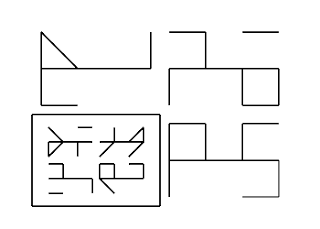
new automatic UDEL tool

Hail Santa at Terminal Velocity invented UDEL, or “Uniform Data Entry Language,” a conlang for Mothership and other sci-fi games. I’ve written this tool to help write it, and while it’s not feature-complete, I thought I’d better release something soon rather than tinker with it forever.

It’s pretty straightforward to use: type the words you want in the box, and click the link to draw them. Words connected by underbars (“_”) will be drawn in a cartouche (i.e. proper nouns). Numbers are drawn correctly, but you’ll have to “pre-process” them, which is to say, break them into groups of 3 digits, etc. If a word is not on the word list, it will be drawn as a blank stave.

Right now the tool is hosted on a Blogger “Page” instead of a proper post, because making it a post somehow hides all the other posts on my blog and I have no idea where to start with that.

Todo

  • Implement underlines. How should they be represented in input?
  • UDEL is nominally symmetrical in many circumstances. I’d like to add an “up” arrow to the left side so that a UDEL plaque, for example, could be oriented from any direction.
  • Implement punctuation.
  • Improve the layout engine. It’s really clunky right now, and strongly favors square numbers of words.
  • Automate representation of numbers.
  • Automate representation of plurals, posessives.
  • Highlight out-of-list words in the input field.
  • Suggest in-list synonyms for out-of-list words.
  • Add a function to export the final image.

Play with it, use it, test it, break it, let me know what you think!

Friday, October 22, 2021

36 ABY: The End of History

(Spoilers below for various Star Wars properties.)

With the final death of Emperor Palpatine, history was ended. The Skywalker destiny doubly or triply fulfilled, the ultimate evil laid to rest, balance restored to the force. There are no more blockbuster movies to be made in the world of 36 ABY,1 but that doesn't mean there aren't stories to be told. Smaller in scope and more nuanced in morals, I think these stories may be ideal for a role-playing game.

If the prequel trilogy took the fall of Rome as its model, 36 ABY takes the collapse of the Soviet Union. Repeated cataclysm and rapid retreat have left fractured militaries in the hands of new nationalist and nativist factions. A hundred empires and a hundred republics blossom in miniature.

What about the New Republic?

The destruction of Hosnian Prime by Starkiller base was a major blow to the New Republic, but not fatal. As the capitol was hosted by new planets from cycle to cycle, the infrastructure to continue existed already. With the New Republic military deprecated in favor of planetary defence forces, the New Republic's might was still strong. Emergency elections were held, business continued.

Well, in theory. The New Republic lives on, but more cautious and milquetoast than ever. Skittish, corrupt, gridlocked, they cannot command the might they have, nor direct it if they could. For now, it adequately prevents its members from open warfare, and freed from the existential threat of the First Order, could be open to a more involved role on the galactic stage.

What about the Empire?

The Empire is dead, but it remains everywhere. When news of the Sith defeat at Exegol spread, a common form of ultimatum was issued by occupied planets to their attendant star destroyers:

No resupply is coming. There is no base you can return to. Become citizens of our nations and serve in our militaries and you can build a new life here. Or else we will chase you off, and who else will take in imperial deserters?

It was a good offer, and many bands took it. Some refused, and ultimately lost these reverse sieges. Others fled and live as interstellar pirates and mercenaries.

Of course not all planets chafed under the empire, and these tended to organize splinter empires around charismatic moffs and generals. They now seek the legitimacy and acceptance that they once enjoyed.

What about the super weapons?

No remaining single faction has the resources to develop a superweapon. No current coalition of forces trusts each other enough to collaborate. More importantly, no superweapon could be developed unopposed: without a unified galactic body, reactions cannot be controlled. That said, there might still be some ancient super weapons around, waiting to shatter this precarious peace.

What about the Hutts?

Undisputed rulers of Hutt space since before the Old Republic, the stability of the Hutts has made them unwillingly legitimate. Hutt space is a rare known quantity, the most desirable place to be doing business. And the demands of this have led to an expansion of their role, and a creeping bureaucracy supporting them. All kinds of ne'er-do-wells find a second career as enforcers, clerks, and lobbyists in the burgeoning Hutt council.

What about the force?

Balance restored to the force, the Jedi order is no more. And yet, there is always a new generation of force-sensitive children and always a need for them to be trained. With no central schools, itinerant masters travel the galaxy, giving lessons and helping out where they can. Several distinct traditions of practice have emerged.

Skywalker

Heroes. Focus on luck, prophecy, visions, destiny. Hard to predict. Ask a Skywalker to protect a village or stop a villainous plot. Most common in the outer rim.

Huyang

Cops and judges. Focus on lightsabers, protocol, structure, restraint. Get along well with droids. Usually raised from a young age. Ask a huyang to mediate a dispute or catch a thief. Most common in the core worlds.

Bendu

Zen monks. Focus on inner peace, sensitivity, nature. Impossible to sneak up on. Ask a Bendu when to plant crops or how to communicate with a creature. Most common in the unknown regions.

Shelish

Witches. Focus on power, nuance, medicine, secrecy. Always women, always at the edge of society. Ask a Shelish for a potion or a curse. Rare, but evenly distributed.

What about the dark side of the force?

The Sith, freed from the rule of two, proliferate, climbing military and political ladders across the galaxy but stymied by their low ceilings. Current threats from the dark side include:

Darth Heret

Once a Skywalker-tradition Jedi, Darth Heret has been corrupted by a Sith Holocron, convinced that he is destined to be a great reformer and bringer of peace. Currently, he leads a widely-feared band of pirates, and fails to see how this is not an obvious stepping stone towards that. An alarming number of his devotees are also strong in the force, and he takes it upon himself to instruct them.

Lady Trace

A youth, perhaps 13 years of age. An orphan of Hosnian Prime with no family to return to. It is said that she can hear the voices of demons in the force, and she keeps no other company.

The Grand Inquisitor

The Empire's special projects division has always had some oddballs. Going rogue after the fall of the Sith, they believe they have grown themselves a new god from the (incomplete) records of the Inquisitorius. This new god will guide them, surely! But their god is a blank slate, an emotionless machine. They weep, for they have power and know not what to do with it. They seek meaningless conflict, hoping this will spark some desire or purpose in the Grand Inquisitor, the vessel of all their dreams.

Perhaps one day, this faction will create Am and Karre.

What else is going on?

  • Improved nav computers are opening up the unknown regions. First to explorers, then to traders, and ultimately to colonists, as these advancements in tech filter down to more people.
  • With so much turmoil, many long-standing grudges created by cycles of occupation and relocation are coming to a head, both at small scales and planetary. When a population is freed from servitude in the spice mines, where are they to go when other farmers have been working their ancestral fields for generations? What of the Alderaanians and the Hosnians? Who gets to prosecute the perpetrators of multiple war crimes? What if their research was really interesting and useful?
  • Darth Heret's underlings all have lightsabers. Where are they getting them?

1 At time of writing there is no canon media of any kind set in 36 ABY or a later year, and the only things that happen at all in the future are jokey framing devices or quasi-canon. Given the sheer quantity and scope of Star Wars material, this continues to astound me.back

Tuesday, February 9, 2021

Cathedrals

Construction on York Minster Cathedral was finished in 1472, having begun c. 1220. For two-hundred and fifty years, the unfinished cathedral was a part of the city, an ongoing project longer than the life of any one person. In that time it brought in specialists and materials from far away and gave work and benefit to the locals.1

Toolbox

This toolbox is intended to quickly sketch a settlement defined by its largest ongoing project. The locals are building something massive, and this is hopefully a shortcut to intrigue and conflict.

What is it? (1d20)

  1. Amphitheater
  2. Bridge
  3. Canal
  4. Casino
  5. Cathedral
  6. Fortress
  7. Greenhouse
  8. Lighthouse (warning, beacon)
  9. Necropolis
  10. Observatory (telescope, supercollider, lookout)
  11. Palace
  12. Power Plant (wind, solar, nuclear, hydro)
  13. Pyramid
  14. Reservoir
  15. Roads
  16. Ship
  17. Stepwell
  18. Tower
  19. Tunnel
  20. Wall

How far along is it?2 (1d12)

  1. Design
  2. Surveying
  3. Permitting
  4. Site Clearance
  5. Excavation
  6. Foundations
  7. Rough Structure
  8. Exteriors
  9. Interiors
  10. Finishing
  11. Cleanup
  12. Warranty Period

What's the hold-up? (1d10)

  1. Beasts
  2. Beaurocrats
  3. Errors
  4. Funding
  5. Holidays
  6. Ill Omen
  7. Labor (shortage, strike)
  8. Materials (quality, supply)
  9. Plague
  10. Vandals

Why build this? (1d8)

  1. Convenience
  2. Defense
  3. Memorial
  4. Religion
  5. Research
  6. Spite
  7. Tourism
  8. Vanity

Who's building it? (1d6)

  1. Condemned Criminals
  2. Locals
  3. Military
  4. Refugees
  5. Slaves
  6. Sleepwalkers

Secret (1d4)

  1. Corruption in sourcing or labor
  2. Design is of occult significance
  3. Roll a second, hidden purpose (1d8)
  4. None

Thanks to David Macaulay.


1 I assume some of this, but it seems reasonable.back

2 Following the example of a cathedral, the barest functional parts may or may not be completed already.back

Tuesday, February 2, 2021

Quest World™ and The Uncanny Hinterlands

Quest World™ is my entry into The Great Troika! Pocket Sphere Jam. For the unfamiliar, a pocketmod is a small booklet folded from a single sheet of paper, and a “sphere” is Troika’s rough equivalent of a plane or a planet. Quest World™ is one part of a stew I’ve had simmering for the better part of a year now, which I call the Uncanny Hinterlands.

The Uncanny Hinterlands

The first ingredient in the Uncanny Hinterlands was the Mothership adventure Hideo’s World, in which the characters enter a decaying virtual world in the mind of a genius game designer (a “slickworld”). It plays with the narrative frames in some interesting ways, for example you can order a coke in the virtual world, delivered to your physical location by drone. It’s also an “excuse” to explore a different set of tropes and aesthetics while keeping it grounded in a larger setting.

The second ingredient was Jared Sinclair’s Prismot zine, which expanded the idea from “I should run Hideo’s World” to “I should convert Hideo’s World to Troika!” I liked the idea of a world like Hideo’s, but that you could also travel to physically,1 a digitally constructed artificial realm of adventure.

That was on 11 March 2020, and on 16 March 2020 I started working from home in relative isolation. Eventually, I picked up RuneScape (OSRS) again, and that influence created the Uncanny Hinterlands, a larger, stranger setting.2 With my notes becoming too unwieldy to usefully think about, the game jam gave me the opportunity to ladle out a manageable portion to share with others.

Quest World™

Quest World™ is most heavily inspired by MMORPGs. I’m fascinated by the morality of RuneScape, where advancement may force you to compromise your morals. In general, there are many one-off or narrow solutions that could not reasonably exist in a normal TTRPG. Debates about violence in D&D and coverage of The Last of Us 2 put the term “ludonarrative dissonance” in my head, which seemed like a natural exploration inside these more complicated narrative frames.

I haven't got to play it yet, but I also wanted to shout out PAGAN: Autogeny as apparently having a similar concept (abandoned MMORPG), although I'm sure there are others.

Kill Arena

The next area of the uncanny hinterlands that I’d like to explore is the Kill Arena: a sphere inspired by classic FPS games. I especially always loved the way that physics glitches become core parts of gameplay or entirely different ways to play. I don’t know if this exploration will be coherent enough to share, but I offer it as an example of other spheres in the Uncanny Hinterlands.

Making the Pocketmod

I composed my first pocketmod at A7 page size, because an A4 pocketmod printed on US letter paper will still fold correctly (the reverse is not true). This time, I did not remember that and started writing at ⅛-size US letter paper. Fortunately, I gave myself 0.25” margins, so I was able to adjust the margins and paper size at the same time for the A4 version.

I used pdfjam for the final layout, which was pretty straightforward. My distribution (Mageia) provides it in the package “texlive-collection-basic” and the command to assemble the US letter-size pocketmod was:
$ pdfjam --angle 180 -o /dev/stdout qw.pdf '1,8,7,6' | pdfjam --nup 4x2 --landscape --paper letter -o qw-us.pdf qw.pdf '2-5' /dev/stdin
where “qw.pdf” is the 8-page ⅛-size US letter layout and “qw-us.pdf” is the pocketmod output. Similarly, the A4 pocketmod was assembled by:
$ pdfjam --angle 180 -o /dev/stdout qw-a7.pdf '1,8,7,6' | pdfjam --nup 4x2 --landscape --paper a4paper -o qw-a4.pdf qw-a7.pdf '2-5' /dev/stdin

I used LibreOffice for writing and layout, GIMP for image editing, Kolourpaint for rough image sizing and cropping, and Pixel Studio on an Android tablet for original art.

I made liberal use of the free resources on itch.io. I used the fonts Nicer Nightie, Silver, and Fool, and I used free 1-bit fantasy sprites and pixel portraits.

I also used several sets of glitch brushes and textures by dataerase. It’s a bit of a hack, but this is how I made them work in GIMP:

  1. Copy the .abr files to ~/.config/GIMP/2.10/brushes (you can leave them in subdirectories).
  2. Copy the folders of patterns from the CSP brushes to ~/.config/GIMP/2.10/patterns (you can leave them in subdirectories and also leave them as pngs).
  3. Using the clone tool, select "Pattern" as the source and select one of the glitch patterns. You can use any brush, but the new brushes will be square.

These aren’t true brushes: the pattern doesn’t scale with brush size, nor does the current foreground color matter, but for painting on pixel-scales in black & white, it worked very well.

Into the Uncanny Hinterlands

There is a lot more in the uncanny hinterlands, so I’m collecting some of the other ideas that inform them here for reference.


1 While some inhabitants of the Uncanny Hinterlands are there via neural uplink, some are using PC terminals, astral projection, or spaceships. Some could be considered “native,” even. back

2 I still have not lost track of my other OSRS-inspired projects, as they are tending in a different direction. back

Monday, December 28, 2020

Crisis on Christmas: Coin Hunt

I’ve enjoyed hearing how people have made use of Crisis on Christmas Prime in the last few weeks. I hope that by providing a brief sample adventure it might be more approachable. I rolled “Rag-tag adventurers are buying up candy!” on the crisis table, so that was the starting point.

Hook

Ol’ Gran Yule has realized that Santa’s bag is a few thousand chocolate coins short. Can you find some before he leaves tomorrow?

Investigation

Loosely, here are some places around town that players might think to look for coins:

  • Pharmacy: none stocked, busy.
  • Rabbi: has a few hundred, will play dreidel for them if you have the time.
  • Candy store: none stocked, bored.
  • Chocolate factory: out of coins, suspicious of anyone who might be an inspector.

All the coins were bought up by three people. Clues given by people who are out of coins:

  • They were all bundled up like they’d trekked in from out of town.
  • They were dirty like they’d been digging or playing in dirt.
  • They paid with palm-sized coins.

These clues should point to the giant-barrows outside town.

Other information available:

  • There were three of them, one blind. They talked about a fourth person too.
  • They were all squinting and smelled burnt.
  • You shoulda seen the shooting star last week!

Getting to the Barrows

This is an opportunity to check for random encounters, and to make sure everyone has taken precautions against the cold. Checking for encounters here reinforces the sense of distance between the town and the mountain, but I didn’t come up with a good table. Aeval and Valmr are out finding supplies and leads, so they might be encountered on the road.

The Giant Barrows

  /--B-D
A<
  \--C-E

A - Entrance

Hewn into mountain base. Checking under snow on wall reveals a carving of a balance with a cross-legged figure on each side.

B - Cold Chamber

Drafty, tall, light filters in through natural chimney above. Snow and ice on the ground, large boulder in middle of room next to a chain extending from the floor to a massive wooden beam protruding from the wall on the right and leaning downwards. (Strength to move boulder.)

C - Warm Chamber

Mirror image of B, except with light filtering up from a large hole in the ground and no opening in the ceiling. (Chain and beam are too high up to be visible.)

D - The Last Giant

Jorg is still meditating very hard and will attempt to ignore all disturbances (damage will rouse him). Some large coins and religious texts free for taking.

E - Order of the Blue Lantern

A band of adventurers between expeditions recuperate in the cave with their new pet, Shiny. Shyren is here, lounging and playing with it, and Istwell is meditating. Remaining coins needed are here. They know they are the mirror of whatever group of misfits finds them, and do not trust them. They would like Shiny to go to a good home, but currently could not lose it if they wanted to. Will not give up the coins until a suitable replacement foodstuff is discovered. All have stats as Knight of the Road. (Names are from The Black Hack.)

Shyren (Thief)

Despite the fur trim, her winter clothes are wildly impractical. Likes Shiny most of all the order, and is trying to teach it tricks.

Istwell (Cleric)

Dressed in Saffron robes, meditating. Can be distracted by the religious texts in D or meeting Jorg. Believes that Shiny cannot see him because he is free from the cycle of birth and redeath, but in fact it is because he is blind (and sees only with his second sight). Knows Coal Resolve, Peace, and Zed.

Aeval (Wizard)

Jumpy, tattooed, elfin. Knows Open, Thunder, and Undo.

Valmr (Fighter)

Bored, aggressive, bearded. Speaks with a heavy, archaic accent.

Shiny

A blinding pinprick of light dropped by the comet last week (Jeffry’s Comet). Its nature is unclear this young, but it could grow up to be another comet, a star, a galaxy, a nebula, or a whole new sphere. Shiny wants food and company. It has only a loose understanding of the people around it, but does try not to hurt anyone.

Food

Shiny will consume any metal or alloy with a melting point below 700°C and be frustrated by metals it is not yet hot enough to consume.

Company

Shiny can only see people whose eyes its light can reach, and will try not to be left alone.

The Barrows’ Gimmick

The construction is a giant scale, currently weighted down by the boulder in B. If the boulder is moved, D is uncovered, and if a weight is added to the other side (in the warm room), E can be covered. It can be used as a trebuchet.

Ancilimander of Argon

A mad marble astrologer in an observatory atop the mountain (“So close to the North Pole, the stars barely wobble at all!”). Everyone in town knows he’s there, but the Blue Lantern and Jorg do not. He can provide the following information:

  • Shiny can likely find its way home if you can get it up past the atmosphere.
  • Melting points of any metal.
  • Jeffry’s Comet passed last week, has been erratic since.

Treasure

Ideally, Gran Yule would have a unique gift for each of the characters. Recommend using Oddmas Oddities from The Hunt for the Great Goose.

Monday, December 21, 2020

Containment Spheres

Until tomorow (22 Dec 2020), the Mothership Discord server is hosting the 20x20 Jam. Make a piece of Mothership content (any sort) in Playscii in 20x20 format, and upload a png to the server. Winner gets a shirt?

I entered this thing, “Containment Sphere 5”.

20x20 is just too dense to be easily digestible, so I thought I’d expand some of it here (the submission itself is still only the image).

  • The map is the net of a regular icosahedron (d20). The repeated letters at the top and bottom are the same room with connecting hallways doubled. The map wraps at the edges of the screen.
  • There is an energy management game implied: it costs 2◆ to pressurize a room and 1◆ to open a door (hallways all have heavy blast doors and fail closed).
  • Additionally some amount of energy is taken each “turn” by “anomaly containment”. The intent is that the +- value is a projection of the next turn’s consumption. (There is already some risk in the present configuration.)
  • What happens when there isn’t enough power for anomaly containment will depend on the anomaly, but it might be related to VENT.
  • WOOD is intentionally weird and vague. It’s a leftover from the derelict generation tables in Dead Planet.
  • I opted not to use any of the available CRT effects. Instead, I drew on my real-life experiences designing operator interfaces for modern LCD monitors using tools from 10-20 years earlier that only go up to 640x480 anyway. The CRT effects all look “fake” to me, but the weird muted colors look very real.
  • Possible missions on the containment sphere might include evacuation, recovery, restoration of power generation, or anything anomaly-related.

I kept thinking about usability, so after I entered I kept tweaking it. I re-keyed all the rooms so that rooms on opposite corners are in the same row as each other in the key. This might be useful if I made an interactive version, because it would aid memory if you rotated the map.

Finally, I wanted a way to communicate the “wrapping” nature of the map. Without making it interactive, animating it seemed to be the way to go. Ultimately I think it hurt the usability too much, but it was an interesting experiment.

Anyway, Playscii is fun and if you’ve got a bit of time today, you can still get your entry into the game jam. Good luck!

Wednesday, December 16, 2020

Crisis on Christmas Prime!

Last year I put together a little seasonal Troika! supplement and put it up for free on itch.io. This year I’ve reworked the whole thing, and I made it pay-what-you-want. Briefly, it has eighteen backgrounds, six spells, twelve adversaries, miscellaneous tables, and a sketch of the land of Arctica. It’s 48 pages of A5, all black-and-white.

Please don’t let the pay-what-you-want feature discourage you from downloading it. If you like, consider it my gift to you. Some people last year had difficulty with the itch.io interface, so there’s a copy here also.

It’s been a long, weird year, and I hope that this brings you some joy.

Friday, December 4, 2020

Tomb of the Serpent Kings (Review)

The adventure I spent the most time with this year was Skerples’ Tomb of the Serpent Kings (TotSK), running it for a group of 5e players. I also made good use of Itai Assaf Raizman-Greif’s 5e conversion notes. There’s more of the dungeon to explore, but I’m reviewing what we’ve had the chance to play so far. Spoilers etc. below.

For the unacquainted, TotSK is a “learning” dungeon designed to ease new players into a classical, more lateral mode of dungeon exploration. It doesn’t have a gimmick, it’s not a full campaign, and it’s not a single-page blank slate. Instead it’s intended to be a mid-sized dungeon that’s simple to run and fun to play, and which is full of “lessons.” The lessons aren’t explicit, but they’re called out for the GM (for example, “valuables sometimes take unconventional forms” or “traps repeat”).

The plan for session one was simple: finish rolling characters and then play through the “false tomb” level to familiarize everyone with the rhythm of the game. The false tomb level works well for this: the players learned the patterns of the dungeon, exercised some creative problem solving, and won some small treasures. The draw of a low-level, “half-session,” discrete amount of dungeon motivated me to try the adventure in the first place.

We spent the better part of the year in the dungeon (and surrounds), and while we’re not done yet, we’re on hiatus for the moment. The players haven’t encountered Baltoplat or Xiximanter, but have met the goblins and explored most of the upper levels.

What Didn't Work

I’d read the hammer trap a dozen times and thought I’d figured it out. But as soon as I tried to run it, it escaped me, my descriptions were inadequate, and the players spent more time being frustrated than they should have. It really wants a rough diagram and just a couple clarifications (which way do the doors open, which side are the hinges on, that type of thing).

There’s a hidden room behind a statue, following the established pattern of hidden rooms behind statues. Two characters noticed that the statue was misaligned (they didn’t tell each other), but having only one other example to work from, and switching contexts, they left it alone. I don’t think that’s a bad thing, but it’s not the clear-cut “lesson” the text suggests.

The 5e rules and playstyle also undermine some of the “lessons” in the dungeon, namely that combat isn’t always necessary. The players saw the Stone Cobra Guardian as a “boss fight” and proceeded to demolish it. The same thing happened to the basilisk. I hope they don’t try to kill the lich, but I'm not even sure they couldn’t.1

In the 5e stat block for the Stone Cobra Guardian, it’s easy to miss the AC bonus from the shield attack. I’d put a reminder in parens after it, but I don’t think it ultimately mattered much.

For all the logic of the dungeon, some of the traps still feel a little fun-house, which leaves me walking an awkward line between the hammer trap (traps will be signposted, avoidable, interactive, etc.) and the stair trap (trust nothing, everything is dangerous, search everything, etc.). I don’t think my players noticed any incongruity, but I wonder what “lessons” they’ve actually learned about exploring a dungeon.

I used the “strange dreams” hook to get the party together because I had no idea what kind of characters people would be bringing to the table.2 I’ve loosely worked out how the dreams work, but the players with the most elaborate backstories are dissatisfied that they’ve been delving so long and neither dreams nor backstory have been relevant yet. (I do have designs to tie it all together, but the characters just keep going the other direction.)

Part of the issue is that 5e combat is not only more likely, but also a bit of a slog. When the players fight the guardian, for example, that's going to take most of that session. So a lot of time is spent fighting, searching, detecting, and prodding which makes the dungeon feel less engaging than it might otherwise.

To help fix this, the 5e adaptation added “Smee,” a friendly goblin, who I ignored entirely. Eventually the players will meet other non-player characters and have the opportunity to roleplay (in the dungeon), but if I were to start again, I would give them that chance earlier.

What Worked

That said, it’s generally been fun,3 and a lot of things have worked really well:

  • The sarcophagus of Franbinzar containing both a foul shifting liquid and also the glint of treasure caused much confusion, as the players dropped the lid back in place before getting a better look.
  • The players have made full use of the unfinished room for stashing supplies and resting. It’s just a good feature.
  • The players do not like the abyss, and take winding paths to avoid it.
  • Killing the guardian means there are now wandering monsters throughout the dungeon, and it also affected the regional encounter table. I don’t know if the players will notice, but it’s satisfying to run.
  • Unlike the hammer trap, the blade hallway was very well received. “That felt very D&D,” to paraphrase our rogue.
  • As we left it, the goblins have just crowned their new king, and there are only three weeks to the next full moon. (The players know what happens then, but the goblins wouldn’t take “no” for an answer.)

Snakeguts

After the players killed the Stone Cobra Guardian, the artificer wanted to search the remains for parts. Between sessions I took the opportunity to think of possible finds:

  1. Ornate gearbox. Runs perpetually, but ticks loudly, giving away your position.
  2. Glowing emerald golem-brain. Evil, but powerless to act.
  3. [Bulky] spur gear, a map etched into it.4
  4. Internal repair sub-golem. Repairs other structures, but rebuilds the original golem if left unattended.
  5. Incredibly articulated hand. Easily used as a prosthetic.
  6. Parabolic golem-eye. Focuses surrounding magical energy like a 4-D camera obscura.
  7. [Bulky] flywheel. Frictionless while spinning.

The characters ended up with the emerald golem-brain, discovered its nature, and proceeded to devise elaborate ways to dispose of it permanently. (They feared that destroying it would free the spirit in it, and that sending it too far away, for example into the abyss, would invite someone to recreate the golem.)


1 Part of the issue is that there’s six of them, and they’re going to be level three next time we start. I decided to start with the milestone XP option, with each “cleared” dungeon level counting as a character level. This worked really well for the first level-up at least, and quickly gave the new players a feel for advancement. I had some other thoughts on 5e here.back

2 It turns out sleeping is less universal than you think once there are elves and warforged in the mix.back

3 Going back to my revolutionary theory that “games are fun.”back

4 I’ve never cared to track encumbrance, but when I have to, I like Electric Bastionland’s system. Roughly, you can carry two [Bulky] items: one in your hands and one on your back.back

Tuesday, November 17, 2020

Two Flavors of Horror and Six Anomalous Media

Flavors of Horror

I’ve been thinking recently about why the early episodes of the Magnus Archives hooked me so immediately. In addition to solid storytelling, I think it’s down to the blending of two “flavors” of horror that I’m a bit of a sucker for, which I’m calling1 skeptical horror and conspiratorial horror. Both of these also work well with the conceits that some information has been withheld or redacted and that ominous but vague warnings have been issued, but I don’t think those factors rise to the level of their own “flavors”.

Skeptical Horror

In skeptical horror, the supernatural elements may or may not be real at all, but people react to them as though they are, and that creates the horror. Often the audience will know if the elements are “real” or not but it hardly matters. It is not necessarily a one-to-one mapping onto “the real monster is man”, but the overlap definitely exists.

Examples include The Wicker Man (1973) and The Lovecraft Investigations.

Conspiratorial Horror

In conspiratorial horror, the supernatural elements are known to the characters and believed to be controllable. The illusion of control can only be maintained for so long, or the audience will lose interest. This lends itself well to tragedies.

Examples include Oculus and Cabin in the Woods. I would also consider SCP to be an example that’s too “static”: I like reading individual entries, but eventually I want more to happen (although it’s been quite a while since I actually engaged with it).

Anomalous Media

With this in mind, I read Dan’s Anomalous Media, and then Semiurge’s Additional Anomalous Media, and I thought to myself, “sure, why not?”

I. The Adiloim Broadcasts

First heard at sunset on September 30th, 1925 in Stuart Australia (now Alice Springs), and heard every two years thereafter, seven days after the Autumnal equinox, broadcasting on AM 950 kHz. For five minutes an androgynous voice repeats a string of seven syllables, then follows 2-3 minutes of glosslalia or gibberish, and finally the word “adiloim” is read by the first voice. The syllables are from no single known language and are different each time. The gibberish is always spoken by 5-7 different speakers, overlapping. Recordings exist of the broadcast from 1957 onwards, excepting 1973.

II. Mandarin is Easy!

A set of six language-learning casette tapes for the Mandarin language. On side A of each casette a woman’s voice reads aloud phrases in English and Mandarin, with pauses for the student to repeat. Side B of each casette consists of “quizzes”: a phrase from any of the previous casettes in either language, a pause for the student to translate, and then the answer. Casettes 1-4 cover everyday pleasantries, food and eating, navigation, and basic technical and scientific terms. Casette 5A covers religious and spiritual aphorisms. The quiz of 5B includes calmly-read pleas to spare the student’s life, interspersed throughout phrases from previous casettes. Casette 6 is lost, but the accompanying booklet indicates it would have covered common allusions to classical literature.

III. 1972 All-Star Series (Full Set)

A full set of heavily-damaged Topps-brand baseball cards from the 1972 All-Star Game. Regardless of the card, each one pictures Rookie of the Year Carlton Fisk in a different uniform and pose. All the eyes have been drawn over with blue ballpoint pen.

IV. Tim’s Root Floppy

A 3.5" floppy disk that appears blank and copy-protected when inserted in a running machine. When booted from, it exactly and correctly diagnoses any hardware problems in a curses-style display or printout, regardless of hardware. Any data on the machine will be lost. The label reads “Tim’s Floppy — DO NOT FEED”.

V. World of The Lost

An early MMORPG, discs can still be found at yard sales, online auctions, etc. The servers are long since offline, but a software patch on several onion sites will allow the game to apparently run without an internet connection (despite its small size). When running in this way there are no other players, and NPCs speak only in rhyming couplets. Most “quests” are inaccessible (due to dialog limitations), but a new quest called “Opening the Way” is available.

VI. Vision of Hades

Oil on canvas, Unknown Belgian, c.1620

A martian landscape, exactly as captured by the curiosity rover’s famous “selfie”, complete with lens distortions. Where the rover would be, a nude man kneels, weeping into his hands.


1 I’m sure “horror theorists” exist and have better names and definitions, and I apologize.back

Thursday, October 1, 2020

Random Events

A random event or “random” is an idea I’m borrowing from the MMORPG RuneScape, although it may exist in other contexts or games also. I thought I’d see what I can learn from the design of RuneScape generally, and this is where I’m starting.

What is a Random Event?

RuneScape is an MMO with heavy repetitive elements. Where there’s repetition, there’s the opportunity to automate, so pretty quickly it was overrun with bot accounts farming resources, getting in the way of other players, and distorting the economy. Random events were an early anti-bot measure: whenever you’re doing stuff, there’s a chance that something strange happens. For example, if you’re chopping down a tree, maybe that tree is actually an ent right now, and if you keep chopping it will break your axe.

Maybe you were just running around, and a talking cat (“Evil Bob”) imprisoned you and asked you to play a minigame for your freedom. Sometimes a drunk dwarf appears and wants to share his kebab with you, but if you ignore him too long he’ll start attacking. You might find when you’re burying bones, that you disturb some existing grave site, and a shade attacks you.

These events were removed from the game as more effective anti-bot strategies were devised. However, a fork of RuneScape (Old School RuneScape, or OSRS) only includes updates that are voted on by the community, and after some revision, random events are still a significant part of that game.

My working definition of a random event will be: “a specific, rare, and unforeseen event that has some chance of resulting from a routine activity, and which demands immediate attention.”

“A specific…”
Random events are pre-defined. This could be considered a limitation of a computer game because it’s common enough to improvise exact rare circumstances in tabletop games. But the limited stable of random events means they have a different feel.

“rare and unforeseen event…”
A random event has to be rare enough that you can’t “farm” it or plan around it. Sometimes you can get a message in a bottle while fishing, but you don’t go fishing for one. Explosive gas might damage your pickaxe, but not often enough to bring two pickaxes.

“…that has some chance…”
My intuition is that they should not be more common than critical hits/failures (5%), and should probably be less common.

“…of resulting from a routine activity…”
In their current state in OSRS, most random events are truly random. They just happen whenever or wherever you are. This is something that computers can do great, but in a tabletop game, it would be tedious to check every combat round (say), for a range of infinitesimal chances that something utterly unexpected might happen. So we will use the older model of random event that happens when you are doing some specific, usually repetitive task.

“…and which demands immediate attention.”
A rainbow is not a random event. If we are going to go through all the work of checking for randoms, we’re going to make them impactful. In RuneScape, this is either because the event will cause you harm, grant you a reward, or literally remove you from your previous situation.

Random Events in D&D

In many ways, random events already exist in D&D. Consider random encounters while travelling: they may not strictly meet the definition above, but they come close. Critical successes might also come close, especially with some sets of house rules, but again fall a little short.

I think the closest thing to them in D&D “canon” as I know it is probably the divine interventions in Deities & Demigods. If you’ve never had the pleasure, Deities & Demigods is a mess of a book. Its purpose is unclear, it has questionable ties to its source material, and the information in it isn’t organized in any meaningful or useful way. Maybe it says something though, that I got rid of my AD&D core books, but never parted with this one.

These are the most promising random events I could find in it:

Action Chance Result God (page)
A believer is reanimated. 2% per level of deceased Arawn appears and fights against the reanimation (75%) or offers a substitute dead person (25%). Arawn (p. 26)
An original composition is sung during battle.1 5% The singer is granted a bonus level for the duration of combat. Brigit (p. 27)
A believer flees from battle. 0.5% The deserter is struck dead. Morrigan (p. 29)
An original composition is performed/spread by others. 1%/5% Great wealth is given to the creator by the lord of the hold, in the form of gold. Oghma (p. 29)
An evil act affects more than 500 people. 0.05% The evildoer is given a disease-causing gift. Lu Yueh (p. 40)
Hastur’s name is spoken. 25% Hastur sends 1-4 byakhee to slay the speaker. Hastur (p. 45)
A tomb with Anubis’ image/consecration is robbed. 5%/10% Anubis appears to kill the robbers. Anubis (p. 50)
A cat is killed. 0.1% Bast either kills the slayer or demands half of their remaining life in devotion. Bast (p. 50)
A character takes a great risk. 5% The gambler is gifted a luck stone. Bes (p. 51)
A good person seeks righteous revenge. 5% All of the avenger’s ability scores are increased to 19 until the deed is done. Horus (p. 51-52)
Someone creates a new magic spell or item. 5% Isis gives the creator a charm to resist the effects of one spell. Isis (p. 52)
Someone/a worshipper/a cleric creates a device that is highly useful. 5%/10%/15% Ptah gives the creator a Thet, an amulet that either allows you to become ethereal once/week, or acts as a one-way anti-magic shell. Ptah (p. 53)
Dryads are in danger/Men are attacking the forest. 1%/5% Mielikki appears to aid her dryads/attack the woodcutters. Mielikki (p. 60)
A believer is reanimated. 1% Tuoni comes to reclaim the resurrected soul. Tuoni (p. 61)
Someone accomplishes a particularly difficult task. 5% Epimetheus gives the person a ball of magic clay that can form itself into any 4th-level creature. The creature then fights the person (60%) or serves loyally until death (40%). Epimetheus (p. 68)
Hermetic arbiters accept a bribe or graft. 15% Hermes punishes the corrupt arbiter. Hermes (p. 71)
A lawful-aligned person breaks an oath. 1% per level of oathbreaker Varuna causes them to be punished. Varuna (p. 79)
A being takes an unusual and great risk (in combat). 2% The gambler makes all their saves and attack rolls for the combat. Kishijoten (p. 82-83)
Beings that are neither lawful nor chaotic dig deeper than 100 ft. 5% Darnizhaan attacks the diggers. Darnizhaan (p. 88)

New Random Events

The interventions in Deities & Demigods are interesting, but mostly still fall short of our definition. For example, many of the activities are not “routine”, and many of the effects are still left up to the GM. So if we want to make our own randoms, let’s start with “routine” activities in D&D (assuming 5e). Skill checks come to mind first,2 so for each skill, we’ll define one event that could happen whenever that skill is tested.

Acrobatics
Now you’ve done it. Whether through quick motion or tense concentration, you’ve slipped into the plane of shadow. You can exit anywhere you like, but the further you go the less accurate your exit will be.

Animal Handling
The king of the cockroaches is impressed by your empathic abilities. Would you be so gracious as to carry him and his retinue back to the outdoors or into the nearest structure? For this noble service, the king will grant you a knighthood! Knighthoods from the king of the cockroaches are not worth much, but are technically valid. Should you kill the king of the cockroaches, insectoid assassins will be sent for 1d6 nights following, but the new king does not bear a grudge.

Arcana
That thing you never quite figured out, you know the one? It just clicked. If you can find writing tools and drop everything you’re doing for the next 10 minutes, you can create a spell scroll of a random spell.

Athletics
Koroibos appears in a flash of lightning! Nude, oiled, muscular, he challenges you to a footrace. If you accept he insists on racing right now on the nearest suitable course (a hallway, for example). He wins and loses graciously, but gives one who defeats him an olive branch. When broken, the branch summons him to assist in one task (during which he automatically succeeds on any Athletics checks). In any case, he leaves in a similar flash of lightning.

Deception
I knew it, and this confirms it! Thou art that same villain! I demand satisfaction immediately! Whatever deception was just practiced, the duelist now believes that the character is responsible for the death of one of his twins, and fights to the death.

History
Whatever knowledge you called forth was an affront to the dead. They demand you retract any statement made, or fight to the death (again). If beaten, the answer to one historical question can be extracted. Nobody else can see the shade in question.

Insight
You understand the true nature of all things, and it is as though space and time stand still. Except for you, and if this was an opposed roll, the opposition. You both have enough time to speak a few sentences or take some decisive action (one “combat” round) before the rest of the world catches up, and after, nobody else will know.

Intimidation
You’ve caught the eye of Maxavogg, a lesser devil. He thinks you’ve got potential, kid. But you gotta learn the basics, review the fundamentals. Tell you what, he’s got a free seminar on the subject, take this card and burn it if you want to try. The seminar is 24 hours, but you’ll come back proficient in Intimidation if you weren’t already, and you’ll be known to a handful of [falling] stars in the infernal org chart. He won’t leave until he’s shaken everyone’s hand. (Thanks, Ancalgon_TB.)

Investigation
You find a tiny blue cog. These things just turn up sometimes and nobody knows why. Still, rich people collect them.

Medicine
Look, Ariel the djinn really meant to study for their mortal anatomy class, but they just didn’t get to it. If you could answer a few questions for them, they could definitely do quick favor for you, say a quick spell or sow some confusion somewhere. The questions are bizarre, but simple enough to answer. If Ariel is ignored, they might steal something shiny before disappearing.

Nature
Isn’t there a children’s rhyme about that lichen over there? “Purple fur and orange leaves / Death the drinker’s soul recieves” Maybe that wasn’t it, but you certainly recognize it. Given 10 minutes’ uninterrupted work, you could probably get a useful dose of poison from it.

Perception
One of the fair folk is hiding a cache. If you stand perfectly still and silent for the next 10 minutes, they won’t notice you’ve seen them and you can retrieve it after they leave.

Performance
A talent agent was in the audience (in the shadows if necessary), and would like to offer you a considerable advance. If you accept, 1d4 fiendish lawyers attack the next time you perform the same song again.

Persuasion
An impressionable dandy is not only persuaded by your arguments, but by your very lifestyle! They loyally follow you around, loudly agreeing and generally being obnoxious. If any sort of combat breaks out they throw one attack at random before fleeing. Left outside of your powerful presence, they quickly grow bored and disappear.

Religion
Clarence, a neophyte angel, needs to help some more good people before he’s allowed into the choir. Will the characters swear they’re really very pure of heart? (Clarence trusts them if they do.) That’s just great, is there anything he can do for them that doesn’t involve direct or indirect harm? Oh, uh, maybe not that big. Huh. Maybe like, he can carry a message or something? When this negotiation is finished, Clarence carries out the task unfailingly, but if no task can be settled on, he’s quite huffy and the character takes disadvantage on their next roll.

Sleight of Hand
No trickery escapes the watchful eye of Constable Dogberry, and that certainly looked like trickery. If you agree to cooperate he’ll issue you a very official looking, if incomprehensible … ticket? Court summons? It’s hard to say. But he’ll be detaining you for the next 10 minutes at least while he writes it up. Put up a fight and well, … Dogberry will probably flee after any amount of damage is dealt.

Stealth
You’re so sneaky! You’re practically invisible! Recall though, that Invisibility has duration of 1 hour. Good luck!

Survival
The hunter has become the hunted! For the next 24 hours, King Herla will hunt the character (sans the entire wild hunt, this is his day off). He can be defeated in single combat, or dissuaded by a boring hunt, but if a quarry evades him for the duration, he gifts them an antler. When broken, the antler summons him to assist in one task (during which he automatically succeeds on any Survival or Nature checks).

Implementation

Tying randoms to skill checks has a lot of potential. Whenever a player goes to roll, they roll a d% alongside, and on a 000, the random event happens. Only rolling when there’s a risk of failure prevents “farming” the events, and rolling multiple dice adds excitement.

Special consideration should be given to group checks. As they exist in D&D now, each member makes the check. To keep randoms rare, they should only be checked on individual tests, or alternative rules for group checks should be used. Similarly, they shouldn’t occur on passive checks.3

Because these events are so rare, they must be applied consistently. Even if the athletics check happens in an anti-magic field, the laws of the universe governing Koroibos’ appearance allow him in and out regardless. Religion checks don’t involve any action on the character’s part, but they can still attract Clarence.

These definitely aren’t ready to use as-is. Adversaries need stats, chases need rules, quizzes need questions, and wishes need limits. In the spirit of the original random events, the difficulty of any challenge should probably be scaled to the character that caused it, so that the event is always “relevant”.

Benefits

The events I sketched out here would fit a high-magic gonzo setting, but I do think some version of the mechanic could be worked into other settings. Even though they occur rarely, they define a setting by the types of unexpected things that occur. And because they have a chance of occurring to anyone, you can lean on them elsewhere in the setting. The cockroach court can be involved in unrelated intrigues, and the impressionable dandy might show up later following some NPC.

Challenges

Random events speak to a kind of story-telling that is rarer in 5e, but more common in OSR games, where the story is largely emergent. Even given some larger plot, a random encounter or roll on a table can recontextualize elements of it unexpectedly. These “story wrenches” still appear in 5e, but the reaction to them is largely negative from what I can tell (consider the wild magic sorcerer, for example).

At the same time, tying them to skill checks is a type of rules maximalism that the OSR does not usually go for. It would be easy to forget to check for these events, especially if there are any quantity of these always-in-play-but-seldom-relevant rules. One possible “clean” solution might be to hook them into a VTT, owning the video-game roots of the idea.

Personally, I think these challenges will stop me from using the idea in its current form, but it was a fun thought experiment, and I think the seed of the idea could be useful.


1 As written, the player needs to sing an original composition for the whole of combat. Like I said, it’s a weird book.back

2 Cantrips come to mind second, which could be a different, but promising avenue to explore.back

3 I’d have to remember to use passive checks more often, to avoid perception having all the fun (or not).back