Showing posts with label places. Show all posts

Wednesday, September 28, 2022

Ritual Entrances of the Palace Semi-Infinite

One of the main inspirations for the Palace Semi-Infinite is The Gardens of Ynn, and one of the things I love about Ynn is the ritual entrance. While I prefer to keep the exact relationship between the palace and reality nebulous, this is an option I'd consider for similar ritual entrances.

The Main Entrance

Anyone can get to the Palace with an invitation. A valid invitation must:

  • be written in ink. Some frequent visitors even tattoo their invitations, although this is considered gauche.
  • state the parties invited. The scope can be specific ("Jane Doe") or broad ("the bearer of this invitation") but must be somehow limited in number ("with a retinue of not more than seven") and time ("before the feast of St. Alouicious in the year 2003").
  • be signed. An invitation will not work for the person who signs it, even as a plus one.
  • be written (technically, only signed) inside the Palace.

Present your invitation to a guard or doorman at the entrance to any building and convince them to open the door for you. When you pass through, you will arrive in a random (but consistent) room of the Palace. (Some people claim that the guard must "announce" your arrival as part of the ritual, but this is in fact unnecessary and increasingly old-fashioned.)

The Servant's Entrance

  1. Find a coin on the ground that is not yours and which you did not see drop. It must be worth at least 12 of a smaller denomination of coin. Pick it up and keep it.
  2. Recite: "I, [insert name], gladly accept this payment for a week's honest work."
  3. Enter thru any unwatched door.

You are marked as a servant of the Palace for the next week. This means:

  • a small bonus to remain unobserved by palace inhabitants (other than servants).
  • a penalty to the reaction rolls of palace inhabitants.
  • you are unable to sign invitations to the palace.

At the end of the week, you will be ejected from the palace (if you haven't escaped already), unless you secure more stable employment first.

Tuesday, February 9, 2021

Cathedrals

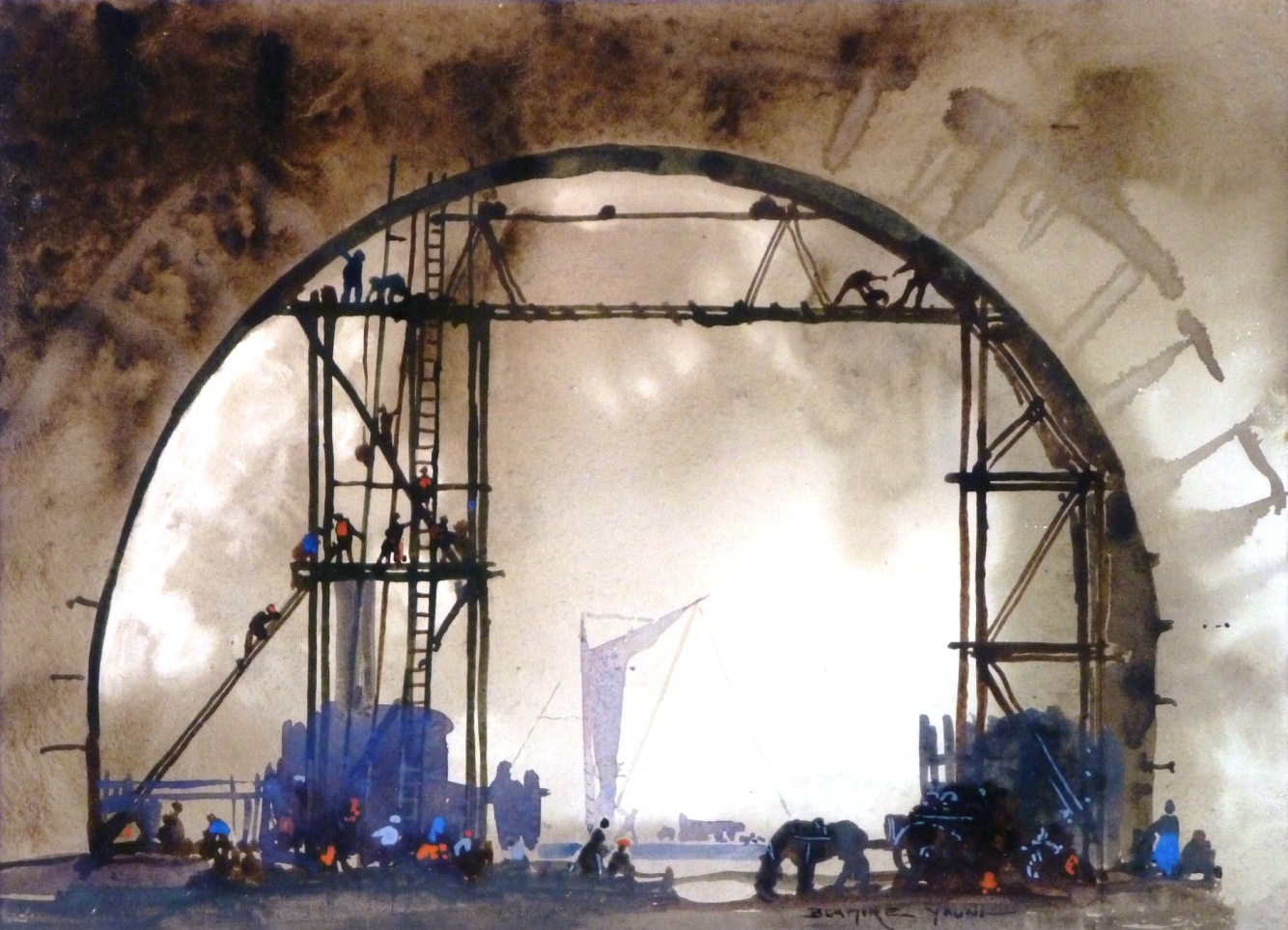
Construction on York Minster Cathedral was finished in 1472, having begun c. 1220. For two-hundred and fifty years, the unfinished cathedral was a part of the city, an ongoing project longer than the life of any one person. In that time it brought in specialists and materials from far away and gave work and benefit to the locals.1

Toolbox

This toolbox is intended to quickly sketch a settlement defined by its largest ongoing project. The locals are building something massive, and this is hopefully a shortcut to intrigue and conflict.

What is it? (1d20)

  1. Amphitheater
  2. Bridge
  3. Canal
  4. Casino
  5. Cathedral
  6. Fortress
  7. Greenhouse
  8. Lighthouse (warning, beacon)
  9. Necropolis
  10. Observatory (telescope, supercollider, lookout)
  11. Palace
  12. Power Plant (wind, solar, nuclear, hydro)
  13. Pyramid
  14. Reservoir
  15. Roads
  16. Ship
  17. Stepwell
  18. Tower
  19. Tunnel
  20. Wall

How far along is it?2 (1d12)

  1. Design
  2. Surveying
  3. Permitting
  4. Site Clearance
  5. Excavation
  6. Foundations
  7. Rough Structure
  8. Exteriors
  9. Interiors
  10. Finishing
  11. Cleanup
  12. Warranty Period

What's the hold-up? (1d10)

  1. Beasts
  2. Beaurocrats
  3. Errors
  4. Funding
  5. Holidays
  6. Ill Omen
  7. Labor (shortage, strike)
  8. Materials (quality, supply)
  9. Plague
  10. Vandals

Why build this? (1d8)

  1. Convenience
  2. Defense
  3. Memorial
  4. Religion
  5. Research
  6. Spite
  7. Tourism
  8. Vanity

Who's building it? (1d6)

  1. Condemned Criminals
  2. Locals
  3. Military
  4. Refugees
  5. Slaves
  6. Sleepwalkers

Secret (1d4)

  1. Corruption in sourcing or labor
  2. Design is of occult significance
  3. Roll a second, hidden purpose (1d8)
  4. None

Thanks to David Macaulay.


1 I assume some of this, but it seems reasonable.back

2 Following the example of a cathedral, the barest functional parts may or may not be completed already.back

Monday, December 21, 2020

Containment Spheres

Until tomorow (22 Dec 2020), the Mothership Discord server is hosting the 20x20 Jam. Make a piece of Mothership content (any sort) in Playscii in 20x20 format, and upload a png to the server. Winner gets a shirt?

I entered this thing, “Containment Sphere 5”.

20x20 is just too dense to be easily digestible, so I thought I’d expand some of it here (the submission itself is still only the image).

  • The map is the net of a regular icosahedron (d20). The repeated letters at the top and bottom are the same room with connecting hallways doubled. The map wraps at the edges of the screen.
  • There is an energy management game implied: it costs 2◆ to pressurize a room and 1◆ to open a door (hallways all have heavy blast doors and fail closed).
  • Additionally some amount of energy is taken each “turn” by “anomaly containment”. The intent is that the +- value is a projection of the next turn’s consumption. (There is already some risk in the present configuration.)
  • What happens when there isn’t enough power for anomaly containment will depend on the anomaly, but it might be related to VENT.
  • WOOD is intentionally weird and vague. It’s a leftover from the derelict generation tables in Dead Planet.
  • I opted not to use any of the available CRT effects. Instead, I drew on my real-life experiences designing operator interfaces for modern LCD monitors using tools from 10-20 years earlier that only go up to 640x480 anyway. The CRT effects all look “fake” to me, but the weird muted colors look very real.
  • Possible missions on the containment sphere might include evacuation, recovery, restoration of power generation, or anything anomaly-related.

I kept thinking about usability, so after I entered I kept tweaking it. I re-keyed all the rooms so that rooms on opposite corners are in the same row as each other in the key. This might be useful if I made an interactive version, because it would aid memory if you rotated the map.

Finally, I wanted a way to communicate the “wrapping” nature of the map. Without making it interactive, animating it seemed to be the way to go. Ultimately I think it hurt the usability too much, but it was an interesting experiment.

Anyway, Playscii is fun and if you’ve got a bit of time today, you can still get your entry into the game jam. Good luck!

Monday, September 14, 2020

The Palace Semi-Infinite

The implicit setting of PALACE RUN. The palace is richly-appointed, labyrinthine, and endless. Some would say “infinite”, but it is surely partly bounded as it has relatively easy access to the outside. The format is from Jack Shear, although I’m sure I haven’t done it justice.

Aesthetics

  • Whole rooms of one color or material, tables set for hundreds, imperial staircases, gilt-framed family portraits, exotic tributes and gifts, the slow approach to the throne.
  • Scaffolding for renovation and construction; kitchens so large they have their own weather systems; secret doors, passageways, and whole hidden complexes for servants.
  • Vast unread libraries, dusty rooms of unknown purpose, sacred crypts and chapels, a lonely child exploring.

Themes

This is an RPG and not a fable. These are ideas to be interrogated, not morals to be enforced.

  • “The rich are different from you and me.”
  • Hierarchy scales poorly. Bureaucracy fills the gaps.
  • Systems are people. Ritual, habit, and operational discipline hold them together.

Adventures

The core of PALACE RUN does provide some rough motivations (“Enrich”, “Entertain”, “Escape”, “Ingratiate”, “Investigate”, and “Overthrow”), but these hooks have a little more meat and should work in a more traditional set-up.

  • The Duchess of the North Wing is to be wed this week, but the baker’s union is striking for better working conditions after a recent outbreak of “doughlung.” She will pay handsomely for a cake, but the provider risks being marked a scab.
  • The palace is of such scale that at any given time, some portion is on fire. The palace bucket brigade does what it can, but after the fire passes through, there’s always work to be done. An imperial magistrate had to abandon their staff of office while escaping, and will pay handsomely for its return. What else might be found if you can beat the recovery crews?
  • The youngest prince of the Southwest Expansion has gone missing! He’s only seven and he was last seen in the Bronze Armory, fiddling with a strange gauntlet.

Designer’s Notes

The first thoughts I had of the Palace Semi-Infinite were merely “what if the adventure site were so fabulously wealthy that it really stopped mattering?” But in the years that it’s stewed since, I think it’s gotten significantly weirder, and hopefully better.

Inspirations

Sunday, August 16, 2020

Automatic Tables

In 2012, I was (and still am) fascinated by the random table. A random table presents an exponential number of ideas in a linear space. Recombinant elements play in the gap between improv and rationalization, making each idea potentially unique and interesting. At the same time, raw probability can be leveraged against this massive scale to emphasize recurring themes or elements, building up a world solely through repeated use and implication.

So I took this fascination and built a bunch of tables that required rolling lots of dice to arrive at vaguely “fine?” results (if we’re feeling generous). Now I have the technology to easily automate these things, and I have done so. They might be more useful this way but mostly it was just fun to revisit them.

Snake Oil

“Doc, get me some more of that bottle…”

Sage Names

“All this we know from the writings of…”

Pulp Materials

“You’ll never stop it! It’s made of solid…”

Pub Names

“Not here! Meet me at…”

Holiday Crises

“I’ve called you all here because the holiday season is under threat!”

Wednesday, October 30, 2019

The City of Emination, a Newer Crobuzon

Following Anne at DIY & Dragons, I've made a city out of some monsters (three "humanoid" minorities and three "bizarre" creatures).

Humanoids

Doppelgangers

Recent refugees of distant war, they are not trusted. Good merchants, negotiators, tour guides. Some rumors about doppelgangers:

  • They bleed a different color (true, but so do some Aasimar).
  • They can read minds (true).
  • They can't stand garlic (false).
  • They'll replace the recent dead (sometimes: they consider dead people's identities "unclaimed").
  • They'll leave you to raise their children for them (false).
  • They'll steal your stuff (rarely: they have different ideas about property).
  • They can't drink alcohol (true, or at least, they can't keep it down).

Ghouls

Unable to enter the inner city (which is hallowed ground) sprawl has forced the ghouls to integrate. Well-fed, they work as laborers. Otherwise they don't think so good and eventually go dormant. Those that let hunger drive their actions are swiftly dealt with.

Aasimar

Aristocratic upper-class, descended from celestials that followed Wormwood (they claim). The original celestials have long since moved on, leaving their progeny to manage the city.

Bizarre

Aboleth

In the city square, a mound of unrotting flesh. It spasms in the rain, and it's good luck if it twitches when you spit on it. It's unknown how it got there, as Emination is landlocked.

The Angel Wormwood (Solar)

Millenia ago the angel Wormwood came to the mountains and there made itself a throne. It never speaks. It has not moved. Ancient pilgrims cut paths through the mountains from all sides, making Emination into an important crossroads.

Earth Elementals

Before the city were the mountains, and the elementals there. Taking the forms of rams and bears, they cut swathes through the outer city until they smash on the inner city walls, raining down charged earth. They always travel in a North-South direction and are more active around geomagnetic reversals.

Other New New Crobuza

There are also some entries from 2009 collected at The Book of Judd. Sphinxcorland (Sea of Stars) was a late addition (2010).

Monday, August 12, 2019

A Town Called January

The challenge this week on the GLOG Discord channel was to detail a city or village or quarter or similar. This is my attempt.

Apollo speaks through his oracle at Delphi, Aphrodite through Dodona, and even the gods of the Celts and the Norsemen all have their own seers. So Janus, among the highest of the Roman pantheon, he too has prophets, established in a town called January. Once, upon the discovery of this gift from Janus, the town grew at an enormous rate. Surely, visions from the gatekeeper of the gods himself must be of a purer, stronger sort, it was reasoned. And they are, for his oracles are two, and both prophecy only the truth. But one will only see the past and one the future, and even they do not know which is which. So the city fell into disrepair and is now mostly a curiosity.

Downtown

The core of January.

  • Joram runs an aging, but still upscale hotel, The Golden Fleece. He is also an expert on military defense and sieges.
  • Hiram is a mask maker who sells them from his cart every day. In the past, the locals would all wear masks on the backs of their heads, but these days it's mostly for tourists.
  • Mayors Miriam and Beelzebub won the least and the most votes for mayor respectively (that's how it works here). They get along together regardless.
  • Pam is the law and head priest around here. She will defer to the oracles on all matters, but they usually don't interfere.
  • Elam is a sculptor of growing renown. He claims not to know where the Wandering Adonises come from, but this is obviously a lie. His main income is sculpting large marble body parts to be offered to the temple (e.g. a large marble foot for foot for a foot problem).

The Temple

A short ways away up a small hill. Here there is a hot spring where people throw lead curse tablets, and then also drink the water for their health. You could probably get some good dirt on people from the accumulated curses, if you're willing to risk a god's disfavor.

  • Seppha and Piper are the two oracles, who all this fuss is about. They used to have more attendants and they're not pleased about the change.
  • Gerontus is the historian. For a not insubstantial fee, he can offer you some insight into which of the prophecies applies to the past, and by extension, which applies to your future.

The Old Town

The ruins of a massive city surrounding the core downtown. Unsavory sorts lurk here, but also just people trying to get by. There's a 50% chance that anything can be found here, albeit in rough shape (blacksmith, horse stable, observatory, waterpark, etc.).

The Quarry

An uncommon bright spot in January's future, Januarian marble is becoming trendy in some circles. The impurities give it distinctive purple veins.

The Orchards

Januarian farmers graft their trees relentlessly, such that something is always in season, and they can practically tell what day of the year it is by what's in bloom. Empty doorframes dot the landscape, but they are not magical and the locals will think it's very funny if people walk through them to check.

Encounters

  1. Boram, a political up-start. He's spreading positive propaganda about Miriam, hoping to snag last place in next year's election.
  2. Hephelot, a general of little renown. He can't afford the pricier oracles, but still wants to know about upcoming battles.
  3. A wandering marble Adonis. They don't speak. There's a few of them around.
  4. A caravan of pilgrims with various ailments, thirsty for the healing waters of the temple.
  5. Filiam, a disaffected local teen attempting to run away to a "real" city. Keeps getting lost in the ruins, but won't admit it. Claims instead that he's looking for something important.
  6. Poram, a massive quarryman. Wears the Janus mask on the back of his head, so looks quite frightening from behind. Needs people to check out a scary cave for him, but won't phrase it like that.

Other Cities

This is only my entry in a second GLOG challenge, these are some others: